Where Second Stage companies work, and where they grow
Three sectors hold 42% of Second Stage jobs, and from 2014 to 2023 Second Stage companies grew slower than their own sector in 13 of 19 sectors.
What we found
Second Stage companies are concentrated in a handful of local-service sectors. Three of them hold 42% of all Second Stage jobs: accommodation and food (4.9 million), health care (4.1 million), and construction (3.0 million). Add retail, professional services, and manufacturing, and six sectors hold two-thirds.
Four sectors run on companies this size
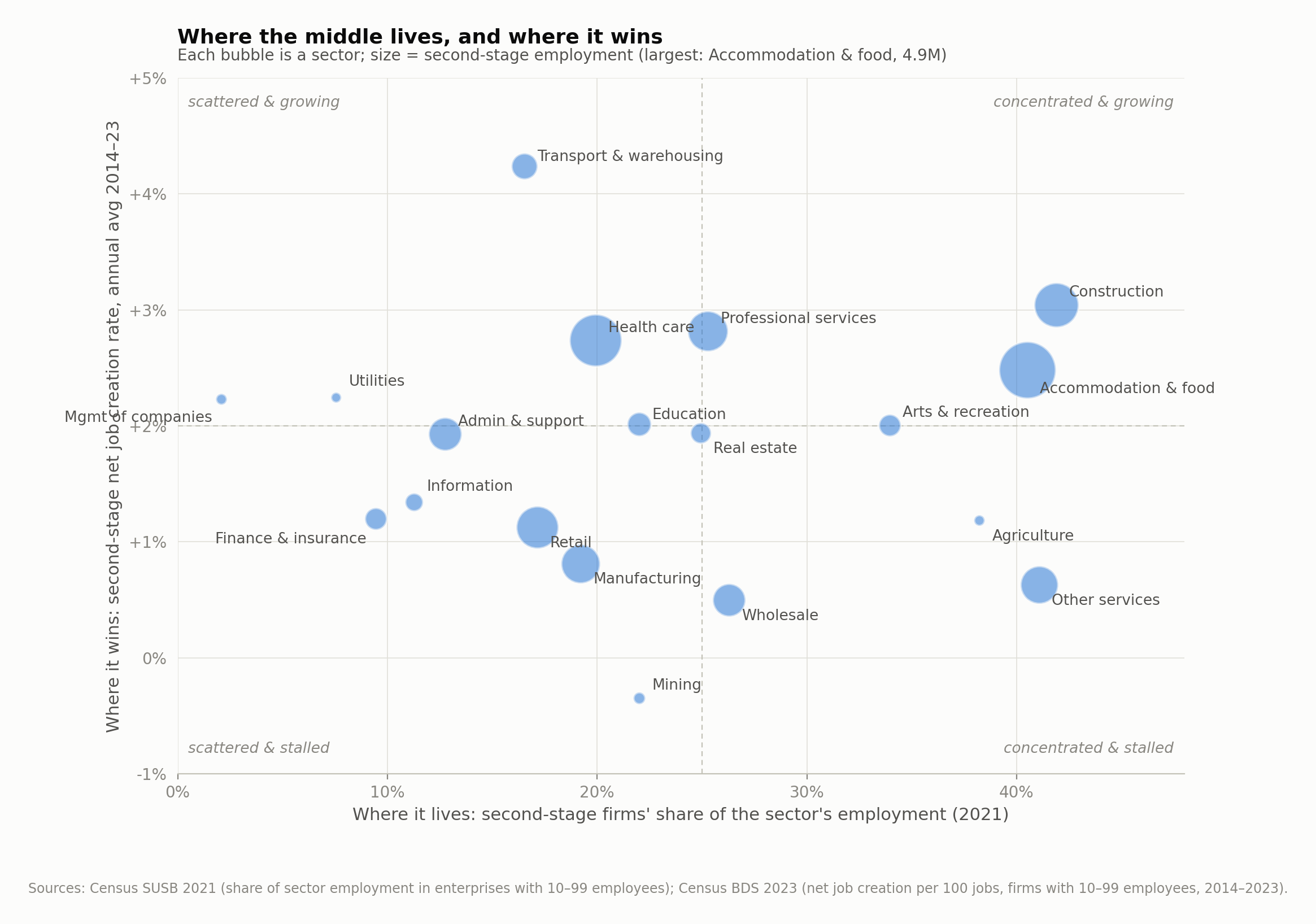
In construction, other services, accommodation and food, and agriculture, Second Stage companies hold about 40% of the sector's jobs. In these parts of the economy, the 30-person company is the typical employer.
Seven sectors are dominated by large firms, where companies with 500 or more employees hold 65% to 90% of jobs. In finance, Second Stage companies hold under 10%. In retail, transport, utilities, finance, and information, firms with 10,000 or more employees alone hold 43% to 55% of the jobs.
The sectors where Second Stage companies are most common are also the lowest-paying. Average pay per employee at Second Stage companies runs from $24,000 in accommodation and food to $109,000 in finance.
Where the middle is common says little about where it grows
From 2014 to 2023, Second Stage companies grew fastest in transport and warehousing, construction, professional services, and health care. They grew slowest in mining, wholesale, other services, and manufacturing.
Across sectors, the correlation between how concentrated Second Stage companies are and how fast they grow is −0.03. Construction is concentrated and growing. Other services is concentrated and stalled. Transport is scattered and growing.
In most sectors, the middle lost ground to its own industry
In 13 of 19 sectors, Second Stage employment grew more slowly than the sector as a whole from 2014 to 2023. The middle lost the most share in wholesale (4.8 points), real estate, manufacturing, finance, and professional services. It gained share in accommodation and food, arts, education, health care, utilities, and mining, mostly sectors where large firms were shrinking or absent.
Professional services is the clearest example. Second Stage firms there added 11% more jobs over the decade, which looks healthy. The sector as a whole grew 23%.
What it means for owners
Your niche matters more than your sector. A Second Stage company competes in a slice of its industry, often a local or specialized one, and that slice can grow while the sector stalls. Sector figures average thousands of companies with little in common.
The sector average is one starting point among several, and rarely the most telling one. The owner's track record, the company's niche and customers, its local market, the strength of its leadership and talent, and the advisors around it usually say more about where a Second Stage company is headed. Those factors carry more weight in a 40-person company than in a 40,000-person one, because a few people and a few customers decide so much of the outcome.
The useful move is to hold your niche up against its sector. A company growing 11% a year in a sector growing 23% is losing position even while it feels like it's winning. A company growing in a shrinking sector has found something the averages miss.
Concentration and pay come from Statistics of U.S. Businesses (2021), measuring the share of each sector's employment in firms with 10 to 99 employees. Growth and job creation come from Business Dynamics Statistics (2014–2023), for Second Stage firms within each sector.
Business Dynamics Statistics credits growth to a firm's average size across two years. A firm growing from 90 to 120 employees has its growth credited to the 100–499 class, so these rates understate growth in sectors where many firms grow past 99. Measuring by starting size instead gives a similar ranking of sectors (rank correlation 0.76).
The 2014–2023 window includes the pandemic. Rankings for 2014–2019 alone are similar.