In small towns, Second Stage companies still outweigh the giants
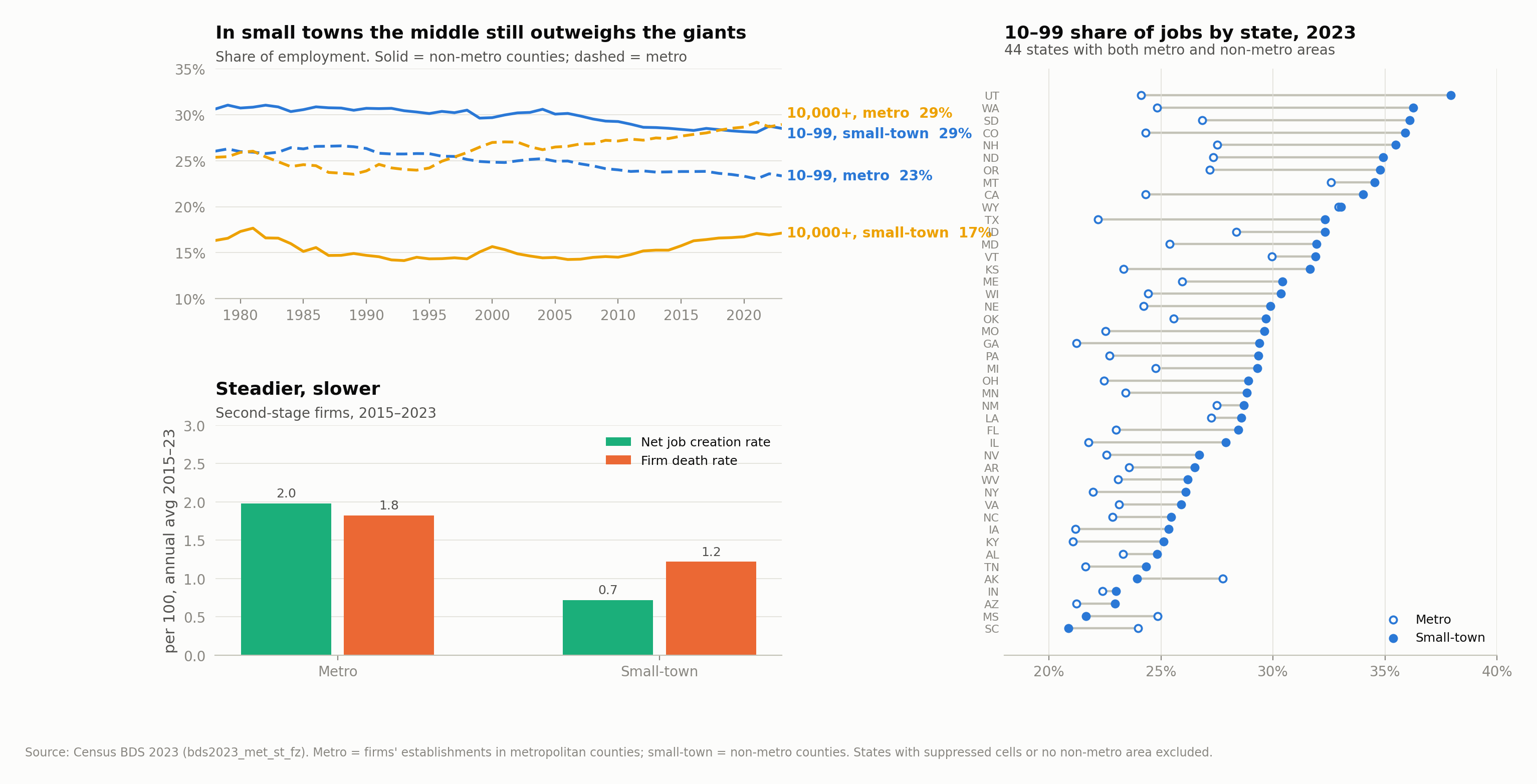
In non-metro counties, Second Stage companies hold 28.5% of private-sector jobs and firms with 10,000 or more employees hold 17%; in metro areas the order is reversed.
What we found
In non-metro counties, Second Stage companies hold 28.5% of private-sector jobs, compared with 23.3% in metro areas. Firms with 10,000 or more employees hold 17.1% of small-town jobs and 28.9% of metro jobs. In metros, the giants passed the Second Stage around 1998. In small towns they never have.
Small towns got a milder version of the shift
Since 1988, the Second Stage share fell 2.2 points in small towns (30.7% to 28.5%) and 3.3 points in metros. Giants gained 2.4 points in small towns and 5.3 in metros. Most of the small-town gain for giants came after 2014, when their share rose from 14.5% to 17%.
Steadier and slower
From 2015 to 2023, small-town Second Stage companies created net new jobs at 0.7 per 100 jobs a year, compared with 2.0 for metro ones. Their firm death rate was 1.2 per 100 firms, compared with 1.8. Small-town Second Stage companies survive better and grow less.
State by state
The Second Stage is a bigger share of jobs in small towns than in metros in 41 of 44 states with both. The gap is widest in Utah (38% small-town vs. 24% metro), Washington, South Dakota, Colorado, California, Texas, and Kansas. Only Alaska, Mississippi, and South Carolina have a smaller middle in their small towns.
In Michigan, Second Stage companies hold 29.3% of small-town jobs and 24.8% of metro jobs, and giants hold 16% and 28%. Michigan's small-town Second Stage share fell 4.5 points since 1988, more than the national small-town average.
What it means for owners
In a small market, your peers survive at better rates and grow at about a third of the metro pace. The limit is usually the market itself. Growing past 100 employees in a small town often means reaching beyond it: a second location, regional expansion, or customers outside the area.
For anyone working on small-town and rural economies, the Second Stage is the employer base. A program for small business in a small town is largely a program for companies with 10 to 99 employees.
The rise in giants' small-town share since 2014 is worth watching. It coincides with dollar stores, regional health systems, and distribution centers moving into non-metro counties.
Metro and non-metro figures come from Business Dynamics Statistics by county. Each establishment is counted where it sits, so a company with locations in both is split between them. Establishments not assigned to a county are excluded.
Metro definitions are current, so some counties counted as metro in 2023 were rural in 1988. That understates how much of the long-run change is reclassification.
Six states lack non-metro areas or have suppressed data and are excluded from the state comparison.