The Second Stage pay gap is widening
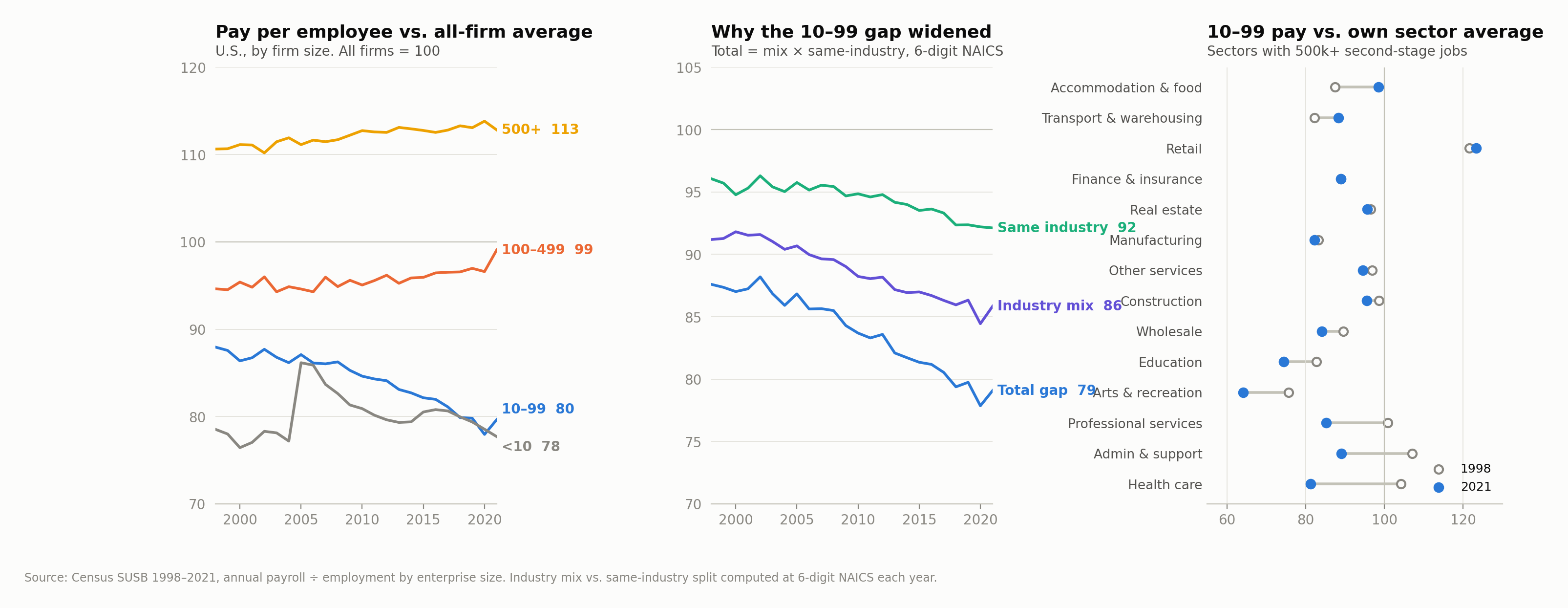
Second Stage companies paid 88% of the all-firm average per employee in 1998 and 80% in 2021; about 60% of the widening is industry mix and about 40% is lower pay within the same industry.
What we found
In 1998, Second Stage companies paid 88% of the average pay per employee across all U.S. firms. By 2021 they paid 80%. In 2021, average pay per employee was $51,400 at Second Stage companies and $64,500 across all firms.
Other size classes moved differently. Companies with 100 to 499 employees nearly closed their gap, going from 95% to 99% of the average. Companies with 500+ employees went from 111% to 113%.
The smaller the company, the faster it fell behind
Within the Second Stage, companies with 10 to 19 employees fell from 84% to 73% of the average. Those with 20 to 49 fell from 88% to 79%. Those with 50 to 99 held up best, going from 92% to 88%.
Industry mix, and the same job paid less
Comparing pay within about 1,000 detailed industries each year splits the widening into two parts. About 60% comes from industry mix: Second Stage jobs have shifted toward lower-paying industries like child care, personal care, food service, and home health, while giants hold more of the high-paying ones.
About 40% comes from lower pay within the same industry. In 1998, a Second Stage company paid about 4% less than the average firm in its own detailed industry. In 2021 it paid about 8% less.
Measuring at the broad sector level overstates the same-industry part. In health care, Second Stage pay went from 4% above the sector average to 19% below, but much of that is hospitals versus home health and dental offices, different jobs rather than the same job paid differently.
Where the gap grew most
Compared with their own sector, Second Stage companies fell furthest behind in health care, information, admin and support, professional services, and arts and recreation. In accommodation and food and in transport, the gap narrowed.
What it means for owners
The sense that you can't compete on pay is partly industry mix and partly a gap you can size. For a 40-person engineering firm, the same-industry gap is the relevant one: about 8% on average, more in professional services. That's a recruiting problem with a known size.
Professional services is the sharpest case. Second Stage firms paid at parity with their sector in 1998 and about 15% below it in 2021, while the sector grew 23%. Talent has been moving up the size curve.
Companies with 50 to 99 employees pay much closer to large-company levels than 15-person companies do. Growing past 50 often brings a more formal compensation structure with it.
Pay per employee is annual payroll divided by March employment, from Statistics of U.S. Businesses. It mixes wage rates, hours, and part-time share, and no public source separates them. Some of the gap likely reflects more part-time work at smaller companies.
Benefits aren't included in payroll. Larger companies' benefit advantage would widen the full compensation gap.
The mix and same-industry split uses 6-digit NAICS industries, computed within each year so that industry code changes don't distort the comparison. Dollar figures are not adjusted for inflation.